
During a five-day trek through the Himalayan Mountains of Nepal, I noticed something remarkable. Elderly women and men were able to drop into a full squat or sit comfortably on the ground, often cross-legged.
It made me wonder: How many 70-, 80-, or 90-year-old Americans could comfortably do the same?
I would venture to say not many. But why does that matter?
- What We Lose When We Stop Squatting
- Knee Replacements Are Increasing
- Mobility Is Also About Preventing Falls
- Start Before You Think You Need To
- A Small Movement With Long-Term Importance
- Want to Keep Moving Well?
What We Lose When We Stop Squatting

In many parts of the world, squatting is still part of everyday life. People squat to prepare food, work, rest, or use the bathroom. The movement is repeated throughout the day, often from childhood well into old age.
Here in the United States, sitting on the ground or dropping into a full squat is often considered uncomfortable, inconvenient, or even “unclean.” Most of our chairs, toilets, cars, and workspaces have been designed so that we rarely need to lower ourselves close to the ground.
Over time, that may contribute to a “use it or lose it” problem. When we stop moving our hips, knees, and ankles through their full range of motion, those movements can become increasingly difficult.
Knee Replacements Are Increasing
Approximately 790,000 total knee replacements are performed in the United States each year, and that number continues to grow as the population ages. Knee replacements are also becoming more common among younger adults and women.
Several factors may be contributing to this trend, including:
- Higher rates of obesity and the additional strain that excess weight places on the joints
- Differences in healthcare and insurance systems
- The use, or underuse, of conservative treatments such as weight management, physical therapy, exercise, and injection therapy before joint replacement is considered
Joint replacement can greatly improve a person’s quality of life when it is medically necessary. Still, I believe we should also be asking what can be done earlier to help people preserve joint function and mobility.
Mobility Is Also About Preventing Falls
Loss of motion in the hips, knees, and ankles can affect more than our ability to squat. It can also influence balance, stability, and our ability to recover when we stumble.
Falls are a serious concern as we age:
- About one in four Americans age 65 and older reports falling each year.
- Falls are the leading cause of injury-related death among adults 65 and older.
- Nearly 3 million emergency department visits in 2021 involved falls among older adults.
- Hip fractures can have especially serious and lasting consequences.
The ability to lower yourself toward the ground and get back up requires a combination of strength, mobility, coordination, and balance. These are exactly the physical abilities we want to preserve as we grow older.
Start Before You Think You Need To
Ideally, we should begin maintaining this movement long before significant arthritis or loss of motion develops. That may mean starting in our 30s, 40s, or 50s rather than waiting until we have difficulty getting out of a chair.
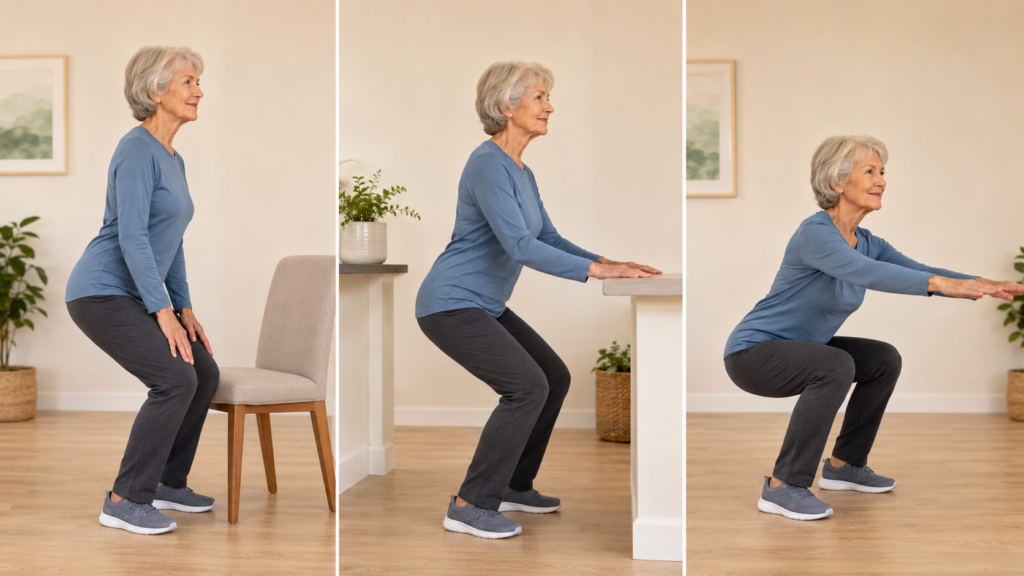
Not everyone should immediately attempt a full, unsupported squat. Existing joint problems, injuries, balance difficulties, or recent surgery may require modifications. You can begin by working within a comfortable range, holding onto a stable support, or using a chair as a guide.
The goal is not to force the body into a position it is not ready for. The goal is to gradually preserve, and when possible improve, the movement your body still has.
A Small Movement With Long-Term Importance
I would like more Americans to consider practicing some variation of the squat several times throughout the day. Even a supported or partial squat can help us work toward maintaining strength, mobility, and independence.
With a little attention now, perhaps more of us can reach old age with our joints still functioning well and, as I like to say, go to our graves with more of our original body parts!
Want to Keep Moving Well?
If stiffness, joint discomfort, or limited mobility is making it difficult to squat, exercise, or move comfortably through daily life, we may be able to help. Contact Onion River Chiropractic to schedule an appointment and learn how chiropractic care, acupuncture, physiotherapy, laser therapy, and specific muscular therapy may support your mobility and long-term health.
Call us at (802) 655-0354 to schedule an appointment.
If you have significant joint pain, balance problems, a previous joint replacement, or another medical condition, consult a qualified healthcare professional before beginning a new exercise.